Science report
Today’s topic is: How are we able to see?
Introduction
One of the five sensory organs and the only organ which we can perceive light or which enables us to see the stuff around us. Yes, I am talking about the Eye.
Eye
The human eye is a sense organ that reacts to light and allows vision. Rod and cone cells in the retina are photoreceptor cells that can detect visible light and convey this information to the brain. Eyes signal information that is used by the brain to stimulate the perception of colour, shape, depth, movement, and other features. The eye is part of the sensory nervous system
Rods and cones
Rod cells are photoreceptor cells in the retina of the eye that can function in lower light better than the other type of visual photoreceptor, cone cells. Rods are usually found concentrated at the outer edges of the retina and are used in peripheral vision. On average, there are approximately 92 million rod cells in the human retina. Rod cells are more sensitive than cone cells and are almost entirely responsible for night vision. However, rods have little role in colour vision, which is the main reason why colours are much less apparent in dim light.
Cone cells, or cones, are photoreceptor cells in the retinas of vertebrate eyes including the human eye. They respond differently to light of different wavelengths and are thus responsible for colour vision, and function best in relatively bright light, as opposed to rod cells, which work better in dim light.
Structure
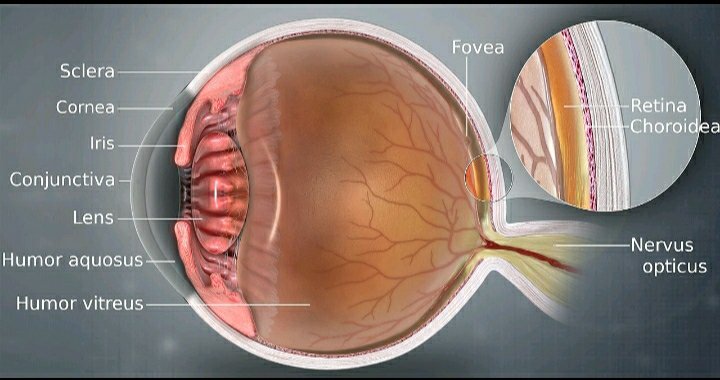
Humans have two eyes, situated on the left and the right of the face. The eyes sit in bony cavities called the orbits, in the skull. Six extraocular muscles control eye movements. The front visible part of the eye is made up of the whitish sclera, a coloured iris, and the pupil. A thin layer called the conjunctiva sits on top of this. The front part is also called the anterior segment of the eye.
Do you know? The eye is not shaped like a perfect sphere, rather it is a fused two-piece unit, composed of an anterior (front) segment and the posterior (back) segment.
The anterior segment is made up of the cornea, iris and lens. The cornea is transparent and more curved and is linked to the larger posterior segment, composed of the vitreous, retina, and the outer white shell called the sclera. The posterior chamber constitutes the remaining five-sixths; its diameter is typically about 24 mm. The iris is the pigmented circular structure concentrically surrounding the centre of the eye, the pupil, which appears to be black. The size of the pupil, which controls the amount of light entering the eye, is adjusted by the iris’s dilator and sphincter muscles. (Sphincter muscles are also present at the ending of the stomach and start of the duodenum)
Accommodation
Changing the curvature of the lens is carried out by the ciliary muscles surrounding the lens; this process is known as “accommodation”. Accommodation narrows the inner diameter of the ciliary body, which he fibres of the suspensory ligament attached to the periphery of the lens, and also allows the lens to relax into a more convex, or globular, shape. A more convex lens refracts light more strongly and focuses divergent light rays from near objects onto the retina, allowing closer objects to be brought into better focus.
Do you know? The floaters which we sometimes see are inside the eye…they are some fat globules inside the blood vessels that get blocked and are pushed by the blood cells.
Myopia and Hyperopia
People with normal vision can focus clearly on very distant objects. We say their far point is infinity. But there are some defects due to eye irregularities which are Myopia and Hyperopia
Myopia or also called short-sightedness happens when a distant object is formed in front of the retina, not on it. The cause may be ageing or the lens may be more converging than normal. Therefore the people who use glasses with a concave lens or diverging lens, which means they have Myopia.
Hyperopia or Far sighted-ness happens when the image is formed behind the retina. This may occur because the lens is less converging than normal. Therefore the people with Hypermetropia(also called) wear Convex or converging lenses.
Bye! Have a great time
 Science Maniac